The tool got in the way
Jul 14 2026 · 4 min read · #ai #opinion #model #agentic-platform
By Aaron Foong, AI & Data Solutions Engineer at AGOS Asia
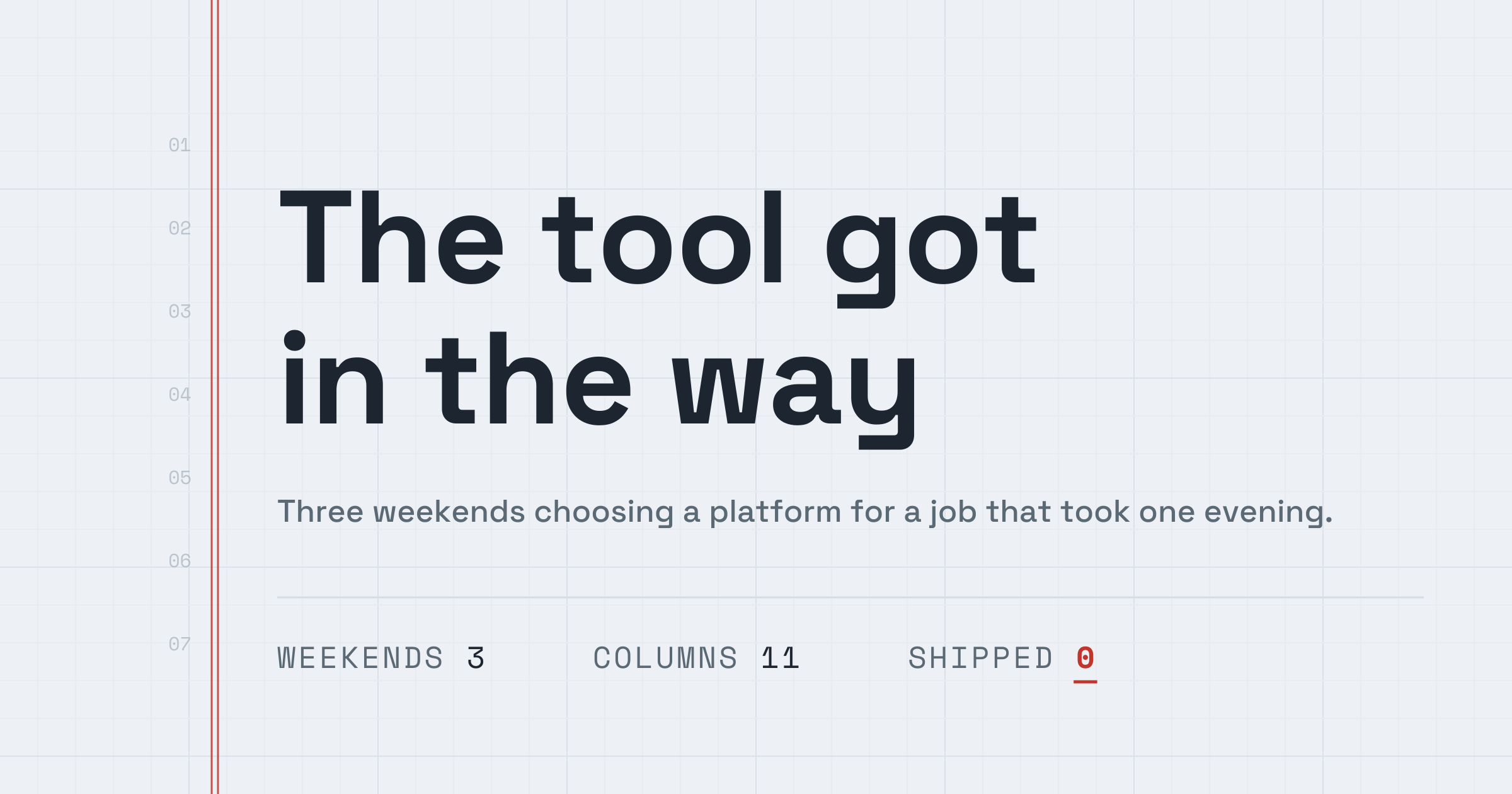
Earlier this year I needed to pick an agentic platform. The task behind it was small: a report that had to be pulled, checked and sent to the same six people every Monday, and I wanted to stop being the one who did it. Copilot Studio could handle it, n8n could handle it, and honestly a scheduled script could have handled it too. But it felt like a platform decision, the kind where whatever you pick becomes the default home for everything you automate after it, so I treated it with what I told myself was appropriate care.
I set up a Copilot Studio trial. I self-hosted n8n, which took an evening of Docker and some fighting with a reverse proxy. I added two more tools to the list because they kept coming up in comment threads. The comparison spreadsheet grew to eleven columns, one of which was “community momentum”. This went on for about three weekends, and through all of it the report kept going out by hand.
Why it felt like work
The strange part is that the evaluation felt productive the whole time. It had the outward shape of work. I was setting up trials, keeping notes, making small decisions, and there was always an obvious next step. None of it could fail, though, because the agent itself hadn’t been started. A half-built agent can send the wrong file to six people and get you a short Teams message about it. A comparison spreadsheet can’t do anything wrong, which I suspect is why it kept growing.
There’s also a point where the evaluation starts justifying itself. By the second weekend the spreadsheet had enough in it that abandoning it felt wasteful, so finishing it properly seemed like the sensible move.
The feedback loop is quicker as well. Watching a forty-minute comparison video at 1.5x feels like research. Reading two strangers argue about webhook reliability feels like due diligence. Both give you the sense of having learned something, on a far more regular schedule than building does, since the early stages of building anything are mostly error messages.
The AI version
None of this is a new habit. People were customising their editors instead of writing code long before agents existed. But the current AI scene feeds it unusually well. A new model ships every few weeks, so keeping your setup current becomes a small ongoing project in itself. I’ve switched default models over benchmark results, for work any of them could have done. Prompt collections grow faster than the documents they were meant to help write. Plenty of people, me included, have connected an assistant to email, calendar and files over MCP and then mostly asked it things a search box could have answered.
Power BI has its own version of this. Somewhere in most organisations there’s a semantic model with clean naming conventions, tidy display folders and row-level security for user groups that don’t exist yet, and no actual report on top of it. The question it was meant to answer is still open.
When the tool actually is the problem
I automate things for a living, so I can’t pretend the tool never matters. Sometimes it really is the blocker: the connector you need doesn’t exist, or your licence locks away the one feature the design depends on. When that happens, switching is the work, and grinding on with the wrong tool wastes more time than any evaluation would have.
The difference, looking back, is whether there’s an end date. A proper evaluation has one. Decide by Friday, build it, revisit in six months if it turns out badly. Mine didn’t, and I never defined what would count as enough information, so no amount of it was ever going to be enough. An evaluation with no end date is closer to a hobby, and that’s what mine had become.
These days I just look at output instead. What did the setup actually produce last month: reports someone opened, automations that ran on their own, anything that left my machine. If that number’s healthy, the fiddling was overhead, and some overhead is normal. If it’s been zero for a couple of months, the tooling has quietly become the project.
How it ended
I went with Copilot Studio, partly on the merits and partly because the report already lived in the Microsoft stack and I’d run out of patience with my own process. The build took an evening, plus another for edge cases, and it’s run every Monday since. At this scale the choice barely mattered. n8n would have done the job just as well, and I think I knew that by the end of the first weekend.
I did come across a new framework this morning though. Agents that build other agents.

Enjoyed this? Let’s talk shop.
I’m always up for trading notes, or helping on a project like this one.